20:20 Vision – a blog of reflections by Matt Peacock
Marking 20 years running arts and homelessness charities with a set of reflections on two decades in the sector and a sponsored bike ride. By Matt Peacock, Co-Director of Arts & Homelessness International
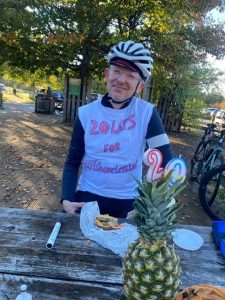 This year marks a few anniversaries – 20 years running charities in the arts/homelessness field, starting with Streetwise Opera in 2002; 10 years since With One Voice began (a showcase for artists who were homeless at the London 2012 Cultural Olympiad which grew into the current charity I co-direct, Arts & Homelessness Int); plus the small matter of my 50th birthday.
On many levels, 20 years working in homelessness is not something to celebrate. They say that the ultimate goal of any charity should be to not exist in the future – well if that is the case, you could argue that anyone working in homelessness has failed. I have made so many mistakes over the years and so many things I would do differently. I thought therefore that I would write a set of reflections on the last two decades including, in my view, what should happen next in our world of arts and homelessness. This will be serialised in this blog with the most recent reflection first.
I’m also marking these milestones with a sponsored bike ride – 20 laps of Richmond Park in London, equating to 220km in a day. I completed the ride on 15th Oct and my Crowdfunding page will remain open until 9th November so there is still time to sponsor me here! I’m incredibly grateful to all those who put their hands in their pockets to help AHI, especially during this cost-of-living crisis – and who helped spread the word and supported me through the challenge with everything from cups of tea to pineapples (see photo!).
Reflection 4: The Power of the Arts – Multiple Solutions to Multiple Needs
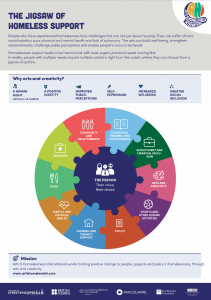
There is a multiplicity of causes of homelessness around the world (from poverty, war, environmental crisis, family breakdown, landlords pushing rents up to childhood trauma) and a multiplicity of consequences (some experience poor physical and mental health, hunger, others isolation, addiction and fear) – and in some situations, cause and consequences merge into one. Too often, homelessness is regarded as only a housing issue when clearly housing is one of a number of considerations that need to be addressed.
Those familiar with Maslow’s Hierarchy of Needs may see the flaw in an otherwise sound model that humans need primary interventions of food, water, and shelter before other, less pressing needs are met, such as education. However, humans are more nuanced and from our research and listening to many people over the years who are or have been homeless, they talk about needing more than the basics from day one.
We explored this in Manchester in 2018 while working with the Manchester Homelessness Charter and the Booth Centre. We asked people who were using the centre what they felt they needed in order to prevent/move on from homelessness. They came up with a holistic, jigsaw approach with interlocking areas of intervention – health care, housing, arts, sports – coming together in one place and at one time rather than a chronological hierarchy. This model became the Jigsaw of Homeless Support and is now being used by orgs and NGOs around the world and was cited as an example of Best Practice by the United Nations. The theory is pretty simple – you need multiple solutions to address multiple needs.
If you consider that, across the world, mental health for homeless people is around three times lower than the general population and in the UK, if you are street homeless, you are seven times more likely to commit suicide, it is essential to address people’s immediate mental health needs. This can be achieved through counselling but often that takes time and it’s the day-to-day moments of connection and kindness that are of more immediate importance.
And this is where positive activities (such as arts, sports, gardening) fit in.
A music workshop or a game of football have many impacts – they are fun, they show people’s skills rather than needs, they bring people together, they alleviate boredom, give a platform for expression, help release tension and stress. If you look further into this (which we did through our 2019 Literature Review of Arts and Homelessness where researcher Phyllida Shaw studied over 60 projects around the world), the 4 most common impacts that all projects demonstrated were: Well-being, resilience, agency and skills. Sometimes these are known as ‘soft’ outcomes but this devalues what is vital to people who are experiencing the trauma of homelessness where these outcomes are often the spark that can change everything. Yes of course, a flat is vital but that has to be accompanied by positive routines and human contact. Recently, AHI facilitated some co-production workshops for Coventry City Council on the new Rough Sleeping Strategy and we asked people what their recommendations were for helping people stay in tenancies – the overwhelming majority said that regular and long-term contact with people was the most important factor.
And every evaluation study I have been involved in that asked people who were homeless what they got out of arts projects, the no 1 reason was friendship and the community. These arts communities are nurturing and positive and often repair some of the negative relationships people have had. Over time, these safe spaces create personal growth and incredible impacts result. All arts projects in our network have countless case studies to back this us – from people finding a reason to live who were on the verge of suicide, to people who had been shut off from social services, finding their voice and belief to re-engage and seek help; and others finding employment and becoming freelance artists.
I’ve learned over time that arts interventions can result in a myriad of positive impacts – almost as many as there are people who take part. One of my favourite case studies was about a man from Newcastle who we were working with when I was at Streetwise Opera. We were running singing workshops in a day centre and the staff in the centre said that Kevin (not his real name) would be no trouble but wouldn’t get involved. Sure enough, he didn’t take part but enjoyed watching the workshops. We let him be but always included him in the conversations. We started working on material that would become a show and we asked Kevin if he wanted to work behind the scenes. He agreed to help out in stage management with another member of the group. As the show got closer, we gave everyone free tickets to pass on to any friends, support workers or family members they chose. I saw Kevin at the premiere with two women and a child – his two daughters he had lost touch during his period of homelessness and his granddaughter he had never met before. Their first meeting was full of positivity and pride – his achievements were there for his family to see. You’re not telling me that is a ‘soft’ outcome.
There is a reason why arts and culture are enshrined in the UN Charter of Human Rights within Article 27 – we need creativity for ourselves and society. In the words of Mark Horvath, the great US homelessness activist and Founder of Invisible People, ‘Arts make us thrive not just survive’.
Finally, in terms of multiple solutions, there is another strand to this – the almost endless ‘entry points’ within arts itself. Not only is there a multiplicity of art forms from poetry to photography, art, fashion, music, comedy and theatre but in each art form there are often many ways to take part. At Streetwise we would often encourage people to perform and sing, partly because overcoming the fear of singing on stage and showing yourself and others you can do it, often opens up other doors of possibility; partly because whole-body experiences like singing and dancing have, in my experience, a particularly positive impact on physical and mental well-being. But, as with Kevin, we were able to offer other ways for people to take part – and even if Kevin had remained a by-stander, he was to us a co-director: Watching and listening and sharing his thoughts and ideas on the action was a really important role.
Everyone working in homelessness wants to reduce the number of people facing homelessness but we’re not going to accomplish that if we only focus on housing.
Reflection no. 3 Dismantling and sharing power… through creativity
One of the most important and exciting developments I have witnessed in the field of arts and social justice is Legislative Theatre and Katy Rubin’s revolutionary work in this area. LT is a method of participatory democracy where real-life challenges and problems in a social issue form the content of short, improvised plays, created with people living those injustices. The plays are presented in front of an audience who are invited to intervene and change the narrative, literally taking to the stage to move the story in a different direction (the practice of Forum Theatre). This often unearths new perspectives on an issue, since creativity can approach problems from a different direction. The new solutions are presented to the audience who vote on which ones to pass and a group of policymakers in attendance commit to implementing the suggestions.
We have worked with Katy so far with Coventry City Council and Haringey Borough Council – in both cases the Councils wanted to co-create homelessness policy with homeless people in an authentic way and for the long-term. Katy and AHI built a group of 8 ‘actors’ in each place (4 people who are/have been homeless and 4 council staff). The resulting plays tackled issues as varied as problems with communication in Job Centres to the barriers people with No Recourse to Public Funds face. The actors remain in place as a Scrutiny Group, ensuring the commitments are accountable and creating a mechanism of policy co-creation all the way through the council (the Scrutiny Group in Coventry, for instance now includes the Cabinet Member for Homelessness, the Head of Housing, the Head of Homelessness and a number of homeless people).
The impacts have been huge – the commitments made in the LT event have been held to and have all gone into the Rough Sleeping Strategies of both Council’s, (such as a commitment to employ more homeless people in council teams in Coventry and implementing a strengths-based way of working in Haringey). Perhaps even more significantly, the whole culture of decision-making has changed in those Councils – it’s much more inclusive and the Council staff are more willing to relinquish power. Like everyone in the sector, Councils are committed to introduce co-production into their work, but they don’t always know how to do it. Legislative Theatre seems to unlock possibilities. I’m am no expert but I have witnessed Katy’s methodology and the way people respond to her and I think there are several reasons why she and LT are so effective:
- Simplicity – the whole process is simple and clear to grasp – you obviously need a top-draw facilitator but overall, the concept is straight-forward to understand
- Replicable – LT can work in many arenas where there is unequal power-sharing or injustices or challenging issues from climate change to corporate settings
- Equitable – the process immediately puts everyone on the same footing (usually a shared nervousness about acting!) and this breads equality and a level playing-field
- Creativity builds trust – the 2 groups of Council staff and people who are/have been homeless quickly bond through theatre games and putting together their plays. They see issues from the other side (the classic example in homelessness is where Council staff see how frustrating the system is to navigate and homeless people see how the staff are often trying to help as much as they can but the central govt rules are inflexible or too complex). This trust enables both groups to explore the issue in a new, collaborative way
- Creativity shows fresh perspectives – it has often been said that creativity (whether it is music or visual art or poetry) can help us see something from a different angle. This is very much the case with LT
- Creativity is fun – it seems trivial but in an arena such as homelessness where there is very little to laugh about, the change of mood also seems to unlock something in people
- Creativity builds confidence and agency to make your voice heard – let’s face it, standing on stage and performing in front of your peers is not an easy thing to do. The process builds confidence which you can see enabling people to put forward their ideas more
- Follow-up is built into the model – having been through the process, the group have bonded and keen to continue meeting. This is ideal since those making the commitments at the event need to be held to account and so keeping the group together really helps to achieve this.Impacts from participatory arts projects come in many forms – and as I will discuss in the next Reflection, in any project I believe there are as many impacts as there are participants. With LT, the impacts are quick, significant and sustainable – it is a joy to be able to witness the power the arts has to help people make fundamental shifts in policy.
Reflection No 2: Pay is Power… Pay is Justice
 With the welcome rise of co-production in the homelessness sector (see Reflection 1 below), there have followed important conversations about equality in many areas related to this – equality of decision-making, power and pay. If you co-design a system which brings down barriers and hierarchies between people, putting them on equal footing, a conversation about pay must come into this – not just fair pay but equal pay.
The Benefits Trap
However, when you start trying to pay people who are or have been homeless for occasional or freelance work in the UK, things become highly complex if they are on benefits. We are, of course, privileged to have a Benefits System – some of our members in other countries could only dream of such a system. And yet, the system is designed with in-build tensions and flaws which keep some people in poverty.
It is not uncommon for even a small payment to result in a sanction where someone’s benefits are decreased or stopped entirely. Added to this, when you rely both on a Universal Credit payment for your living costs and Housing Benefit to pay your rent, you simply can’t afford to take on any work unless the pay is more than these two benefits combined. When you consider that a lot of work in the arts is sporadic, with intensive projects and then a gap, unless we can give someone a regular or permanent job, they will understandably not be able to take it. Many charities we talk to want, desperately, to pay people for appearing on interview panels, speaking at conferences, running workshops and projects, being commissioned to create art etc.
There are some Benefits, for instance in the disability arena such as ESA which allow ‘permitted work’ but even then, our members complain of a lack of clarity and the stress in not knowing when and if they will be sanctioned. And then there is the added frustration and injustice when accepting work somehow calls into question whether you qualify as being disabled in the benefits office’s opinion.
This has resulted in wave upon wave of people in our sector being offered work which they have to turn down – work that would raise their confidence and skills and enable them in some cases to gradually build up their CVs to get back into self-employment or regular part-time and full-time employment. And even for those who can’t transition into work e.g. because of their health, taking on occasional work is incredibly positive for themselves and the economy. The net result is that thousands people are in a benefits trap.
The situation is even more complex for those who have No Recourse to Public Funds – you’d think paying people not on benefits might be easier but most people in this category don’t have bank accounts and as an audited charity, we can’t give out cash payments.
What are the Solutions?
I have spoken to benefits professionals who don’t understand the system fully; other colleagues have even hired advisors who can’t find a solution for a system which, in its current form is too complex and inflexible to enable people to take on occasional work. The system change that most people want is ‘flexibility’ – where permitted earnings are allowed over and above benefits annually (not monthly). This could mean that one month, you could take on some work and receive a lump sum without being sanctioned; other months when you are not working, you could just receive your benefits entitlement. So long as you are under the threshold of the agreed annual permitted pay, you won’t be sanctioned. This would suit most situations, especially in the cultural sector which needs freelancers but can’t pay everyone every week. And to pacify the curtain-twitchers shouting ‘Benefits Cheat!’, the ‘extra’ earned income could be taxed at source so that the employees and the economy benefit.
People who would eventually like to get back into work in our sector also want to see a longer transition period where there is time to move forward gradually and with confidence and security. Let us not forget that many people who have gone through homelessness have also experienced multiple issues and traumas where being ‘ready for work’ is incredibly complicated and nuanced.
And for most people I have met, a combination of some work and some benefits is ideal long-term – the reason being that it helps people feel they are being fairly rewarded for their work, they are contributing, feeling useful, keeping busy, connected, having a purpose and an identity. Working Tax Credits should be a solution, but these are now folded into Universal Credit, making the situation more complex.
Meanwhile, other solutions to paying people seem thin on the ground – cash payments are not possible because they need to be declared by the employer and employee. And the work-around that some charities use of giving vouchers to people on benefits to thank them for their time or buy them art materials or equipment is fraught with difficulties. Although welcomed by some, it ghettoises others and it is legally problematic – a voucher is not a substitute for a payment or else it would be in breach of benefits rules.
When to pay – the ethical question
Another part of the debate is around the circumstances when people who are/have been homeless in our sector should be paid for their work and the (sometimes) grey area around arts participation. Our field is full of participatory arts projects where creativity is used as a valuable tool for personal well-being, community connections, building resilience, confidence and more. Here, in my view, arts participants should be able to join such a group for free and not expect to pay or be paid – just like many choirs or art groups in towns across the world. I would also weave most performances/exhibitions into this category – when you rehearse, you often want to perform and shouldn’t necessarily be paid for that. If the group is not-for-profit and sells tickets and the revenue goes back into making the project happen, most members would feel they shouldn’t get paid.
Where payment should come into the conversation is when people are being asked to do something specific that is drawing on their ideas and expertise. Inviting people to speak on panels at conferences is the classic example – and too often, the panels are filled with salaried staff who are there on ‘company time’ (i.e., being paid their usual salary) and the token person who is homeless is the only person therefore not being paid and the person who often has the most important ideas and reflections to make. And as co-production grows, so too are the occasions where people who are or have been homeless are being asked to join meetings and should be paid for their time. This is a hot topic not only in the arts and homelessness sector – we also chair the Arts and Social Outcomes Group which is the network of networks of charities working in arts and social action – criminal justice, health, aging, asylum seekers etc. We discuss this issue hotly.
Conclusion
Many of the societal injustices we see today are the result of unequal power – in race, wealth, gender, class… charities in the UK must ensure they are not perpetuating power injustice. We must all look at our projects and ask who is making the decisions and who is being paid for them. And in the complex tangle of ethics within payment, benefits, moving from ‘member’ of the charity to ‘staff member’, we should look at each situation on a case-by-case basis, and ask ourselves, are people being exploited? There is a danger of only seeing people as a ‘volunteer’ or ‘participant’ for ever more. We must not hide behind complexities in benefits and make excuses for not paying people fairly because they are on benefits, or that the arts world is a hard profession to get into – we need to find systems which are legal but can enable people to be given positions and fair pay. For many, the arts sector has been a way to get out of poverty and we must talk about this more. To ignore the issue of fair pay is keeping many people in poverty.
AHI is planning an event to discuss fair pay – if you are interested in being part of it email me matt@artshomelessint.com
Reflection no 1. ‘With’ not ‘for’ – the unstoppable momentum of co-production
When I first set foot in a homeless centre, at the end of the 1990s, the nightshelter was full of passionate staff and volunteers ‘helping’ people who were homeless – I’m confident that not one of them had experienced homelessness themselves. It was the norm that homeless charities were run by homeowners.
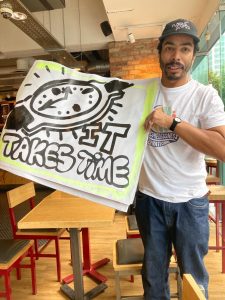
In the last five years there has been a wave of co-production sweeping across the UK and beyond. Services are changing from working ‘for’ people to working ‘with’ people. Homeless agencies and other charities realise that it is not only ethically important to involve people in the design and delivery of services, but it also makes practical sense: People nearest the pain are often nearest the solution.
Furthermore, we are gradually getting away from the assumption that people who have gone through a traumatic experience are somehow in deficit – in our experience, the opposite is true. Often, if you have gone through something as horrendous as homelessness, this can build your resilience, your risk-taking and your empathy. When you consider that these attributes are attractive in the workplace and resilience is the no 1 quality that many businesses look for, it is a missed opportunity not to enable people who are or have been homeless to work in homelessness. The sector is beginning to talk about what is ‘strong’ about you not ‘wrong’ about you.
We see this every day at Arts & Homelessness Int where 50% of our board and staff are or have been homeless and we have started the first leadership programme for creatives who have been homeless, the Associates Programme (see Mitchel Cheney, one of our Associates, left with an important message about co-production).
Working in this way has its challenges, but the net result is that, as a charity, we are stronger and better. Our brilliant colleague, David Tovey is now co-director with me. More people with lived experience need to be at the top of companies and people like me need to move to the side to make this happen. Orgs like Expert Link, Our Agency and Museum of Homelessness are leading the way in this.
Co-production is pioneering and although there are some excellent resources and working practices, there is still no definitive ‘how to’ guide. Co-production can also be done in a tokenistic way where organisations speak to people with lived experience in consultation processes where the org retains 100% of the power and decision-making ability.
We at AHI are not experts although we are a co-created charity – we make mistakes every day and are finding our feet. But through that process, we have collectively created a set of principles that are guiding us and which we offer to others in capacity building sessions. These fall into two categories – 10 cultural considerations and 10 practical considerations:
10 Cultural Considerations for Co-Production:
- Normalising co-production – every meeting, event, project, board meeting being representative. As the disability movement so brilliantly puts it, ‘Nothing about us, without us’
- Create a working culture routed in kindness and what is strong, not wrong about people – almost everyone has some kind of Impostor Syndrome and a supportive, kind and affirmative culture will go a long way in helping people have the permission to believe in themselves
- Create safe spaces – that are trauma-informed; where everyone is encouraged to be there on their own terms rather than how you would want them to be; regular breaks; where there is no such thing as a ‘stupid question’; where there is a some fun or ice-breakers and where there is a someone who people can talk to if they need to (and who can then signpost them to other support if needed)
- Give away power to create power
- Many voices are better than one voice
- Welcome the unexpected
- All voices are equal
- Equality of intellect – a concept borrowed from some of our Canadian members
- Co-production is everyone’s responsibility
- Co-production should run through the whole organisation like the writing through a Stick of Rock – wherever you look at the org, the same ‘writing’ – the same values of co-production should be there. E.g. consider what a co-created job-interview could be like?
10 Practical Considerations for Co-Creation:
- Use a strengths-based approach, especially when co-creating job descriptions
- Learn from each other’s needs and ways of learning – some people may prefer to have short meetings or need time to process; some people don’t find pubs a comfortable environment
- Create pathways for power-sharing
- Take time – it may take longer than you think
- Communicate – keep talking and create communication routes for anyone who needs a chat
- Be flexible – if things don’t work, look at other solutions
- Use the principle of ‘Freedom Within a Framework’ – have some scaffolding round projects in terms of ‘givens’ instead of a blank page
- Create a support structure – consider a well-being budget and budget other pastoral support e.g. sessions with a counsellor as well as regular check-ins
- Plan everything with a Before, During and After:
Before… includes chatting to people about expectations and answering questions and demystifying;
During… includes creating a safe, brave and inclusive space with the considerations outlined above;
After… including check-ins, talking about how it went, what are the next steps etc - Just do it! It doesn’t have to be perfect before you start
To sponsor me on my 220km bike ride for AHI, visit my Crowdfunding page here. Thanks!
Back to News.